Why We Built Twin1
www.guillaume-heraud.com
Today, we launch Twin1 AI, a platform that gives every professional an AI Twin to amplify their expertise and securely tap into the collective knowledge of their organization.
Twin1 comes out of three convictions.
First, we are deeply frustrated by the way much of Silicon Valley has approached AI: as something done to you rather than for you.
Too often, human dignity, privacy, consent, and governance are treated as secondary concerns, or as temporary inconveniences on the road to scale. This is not only morally wrong, it is also a terrible way to build technology that people will actually trust. We have written and spoken for some time about the trust crisis in AI, especially in regulated and high consequence environments, and we believe adoption will not come from asking people to surrender agency to opaque and sometimes hostile systems. It will come from building AI that respects human boundaries, preserves control, and earns trust.
We want to build AI that amplifies your voice, respects your privacy, and gives you back time, focus, and agency.
Second, we have unfinished business with enterprise knowledge.
At our last company, Eigen, which most of us founded and later sold, we digitized more than $100 trillion of financial contracts for half of the world’s leading banks and law firms. We were also the first AI company to receive regulatory approval from the Federal Reserve and FDIC to process financial contracts without a human in the loop. And yet, despite all of that, I came away with the conviction that we had solved only a small fraction of the real knowledge problem.
Why? Because knowledge inside organizations is not simply stored in documents; it is both siloed and distributed.
Some knowledge is siloed inside a single person’s inbox, notes, habits, or memory. Other knowledge is distributed across multiple colleagues, multiple systems, and multiple fragments of context. The most valuable answer often does not live in one document at all. It lives in the chain of negotiation that led to a decision, the side conversation that explained a risk, the judgment call made by a partner, the memory of why a team chose one path rather than another.
At Eigen, we saw this explicitly. We were serving a major law firm with 10,000 stock purchasing agreements (a type of contract). In the pre-LLM era, it was a major technical feat to extract all of that and make it queryable. Once done, someone could ask a question like: “what percentage of buyers gave up this term?” The system could answer: “20 percent gave up that term”. That was useful.
But it was not the real question. What people actually wanted to know was: under what conditions did the buyer give up that term? What negotiation pathway led there? What mattered in practice? What was the commercial context? That knowledge was rarely cleanly represented in any tool or system. It sat in email chains, meeting notes, chat threads, and in the heads of the people who had actually lived through the matter.
That is the real enterprise knowledge problem. And it has only become more important in the age of AI.
Like humans, AI systems are hungry for context. But the context is usually private, messy, fragmented, relationship-dependent, and often governed by permissions, ethical walls, confidentiality obligations, or simple human norms. You would never let a junior colleague freely rummage through another colleague’s inbox. You should be even more careful about letting an AI agent do the same.
This is why we came to believe that solving enterprise knowledge requires solving privacy and governance at the same time. In fact, the two problems are inseparable. The challenge is not just retrieval. It is frictionlessly surfacing the right context from private data, without breaking permissions, trust, or compliance.
Third, we are concerned that AI, if built carelessly, will lead to knowledge collapse.
At a civilizational level, we already see the early signs of enshittification of knowledge. AI systems tend to over-index on what is common, legible, and statistically frequent, while underweighting what is rare, nuanced, original, or deeply contextual. They are very good at averaging. They are much worse at preserving the spikes of human judgment that make expertise valuable in the first place.
This matters inside organizations too. If generic AI output is repeatedly written back into the knowledge base, then over time the system starts feeding on its own flattened approximations, like Orubis, the snake eating its own tail. AI slop produces more AI slop. The average becomes the training data. The training data produces a worse average. And slowly, the distinctive judgment, the texture of knowledge if you will, of an organization gets washed out.
We have seen versions of this firsthand. In one large bank, an AI Search system could often produce acceptable, lowest-common-denominator answers. But what people really needed was not the average answer. They needed the judgment of the right person, with the right context, at the right time.
Building Twin1
So a deeper question emerged for us: how do we preserve and amplify the unique spikes of human expertise, rather than flattening them into generic output? How do we make collective knowledge better than the average, by connecting the peaks?
That is the question that led us to Twin1.
At its core, Twin1 asks:
How can I share my context, knowledge, and experience frictionlessly and automatically, in a way that respects dignity, privacy, governance, and the realities of how organizations actually work?
And more importantly:
How do we make sure AI works for us, rather than being done to us?
Our answer is the digital AI Twin. Twin1 allows each professional to create an AI Twin: a real-time model of their knowledge, judgment, and working context, together with a privacy and communication layer that governs how that knowledge can be accessed and shared. The Twin is trained on the systems where work actually happens, including email, messages, meetings, files, and workplace tools. But it is not just a better enterprise chatbot or AI Search. It is designed to reflect the individual: what they know, how they reason, how they communicate, and what boundaries they want respected.
Just as importantly, each Twin is permission-aware. Users and administrators can control what the Twin can access, who it can speak to, when it can respond, and what requires explicit approval. Sensitive knowledge is not flattened into a generic central pool. It remains tied to the person, permissions, relationships, and context that created it. That is what makes it usable without making it reckless.
The Twin lives where work already happens: in Slack, Microsoft Teams, email, and other enterprise tools. It can help answer routine questions, draft messages in a person’s own voice, and reduce the endless interruptions that turn experienced professionals into organizational bottlenecks. Other AI tools can also become more useful because they can access governed context rather than operating blindly on generic or decontextualized data.
The result is simple: routine knowledge-sharing and internal communication can be automated, people get time back, and individual expertise can be safely extended to colleagues and AI systems without surrendering control.
But the individual Twin is only the beginning.
In most knowledge organizations, the human is the atomic unit of knowledge. The real opportunity is what happens when those atoms can be connected and coordinated together.
That is why we built the Twin Network.
A Twin Network allows digital AI Twins to coordinate with one another, find the right expert, gather permission-aware context across colleagues or departments, and return the best answer quickly. Instead of forcing someone to manually search, host a meeting, or blast an email to find scattered knowledge, the network can surface the relevant context from the right people in a governed way. In this sense, Twin1 is not only a personalized AI agent, it is also a governed context and coordination layer for the organization.
This is especially important because the highest-value enterprise knowledge is rarely neat or pre-curated. It sits in the informal, untagged, and often overlooked parts of work: email threads, back-and-forth discussion, institutional memory, tacit judgment, or retiring colleagues. If all we do is search the clean, formal systems of record, we miss the real thing. The goal is not to replace those systems. It is to connect formal knowledge with informal knowledge, and do so in a way that respects ethical walls, confidentiality, and organizational risk tolerance. We believe this is how AI will truly become useful in the enterprise: not by replacing human expertise with a generic model, but by preserving human context, extending human judgment, and letting knowledge flow safely through the networks where real work already happens.
That is what we are building at Twin1.
An AI that works with you.
An AI that speaks in your voice, not over it.
An AI that helps organizations compound their knowledge rather than collapse it.
And an AI future in which privacy, governance, and human dignity are not obstacles to progress, but the foundations of adoption.
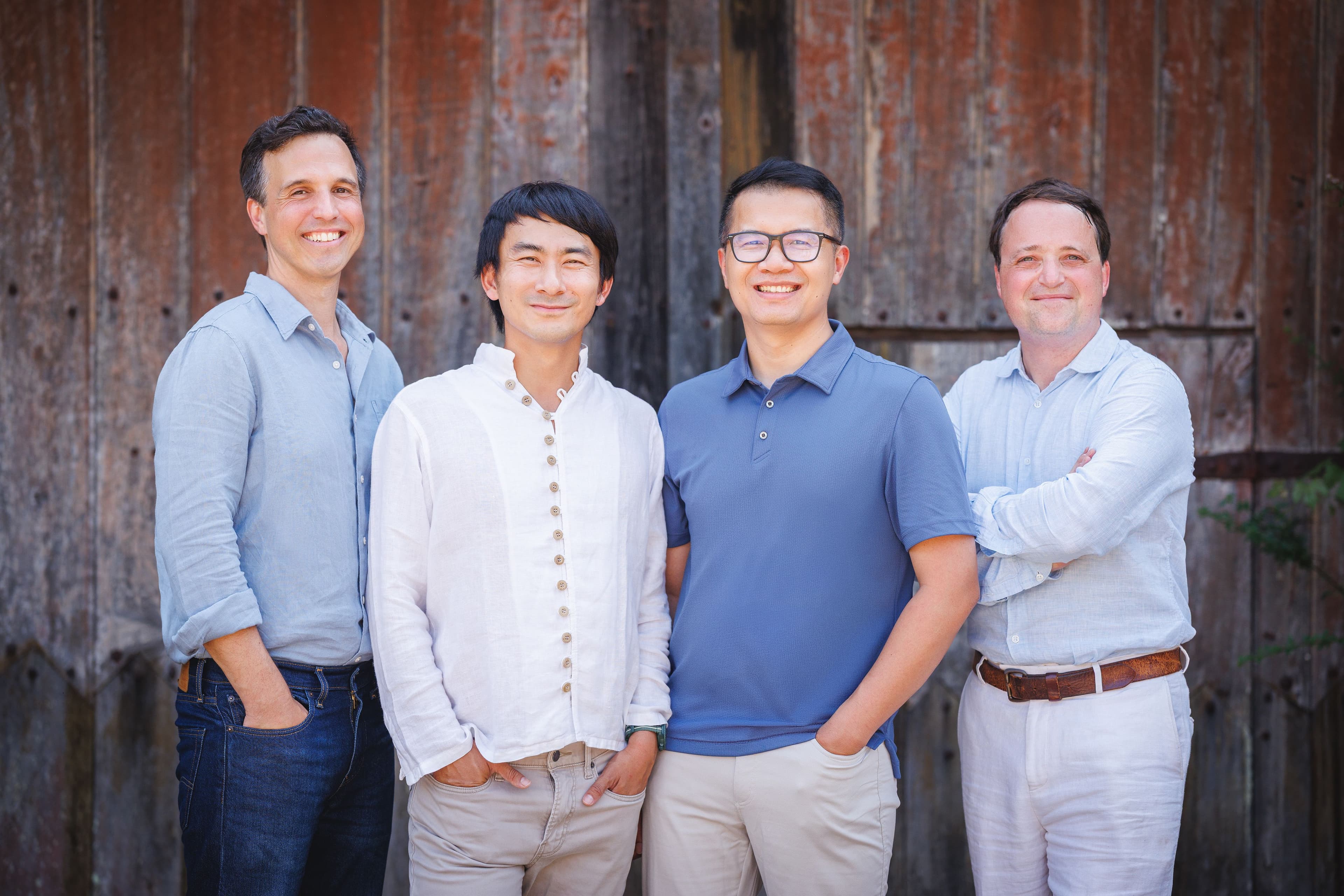
Lewis, Huiting, Jonathan, and Tom