The Dream I Couldn’t Finish Ten Years Ago Became Twin1
Today (2026-11-18), Facebook sent me a notification: “You have memories to look back on today.”
I clicked on it and found a photo from ten years ago, when I was still a student at Carnegie Mellon University, attending a lecture by Yann LeCun. The talk was titled “The Next Frontier in AI: Unsupervised Learning.”
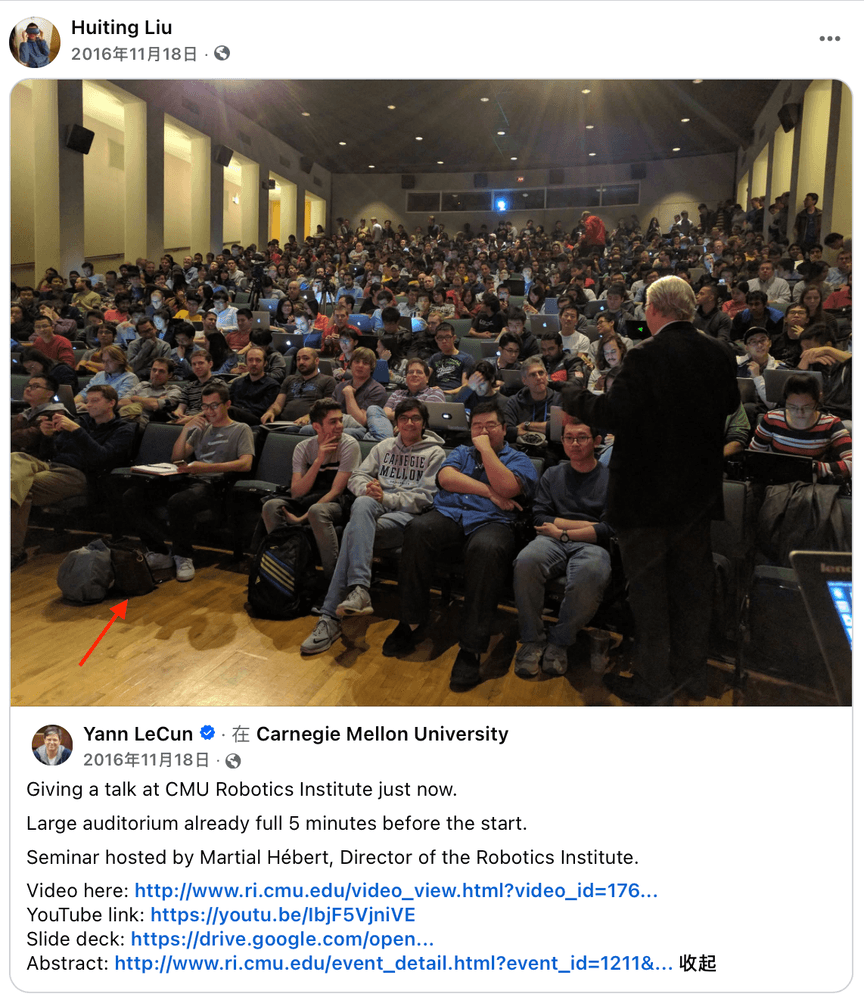
What's interesting is that the unsupervised learning approach he advocated back then was conceptually aligned with the self-supervised learning paradigm that large language models would later adopt, learning language representations by predicting the next token. Back then, he was not quite the Yann LeCun we know today, known for his outspoken criticism of the direction taken by LLMs. Of course, looking back, I also remember him discussing ideas about how the world could be learned and represented. In retrospect, you could already see the early traces of the World Model approach he advocates today.
Ten years ago, everyone was searching for the next frontier of intelligence. Looking back now, ideas that had not yet diverged into distinct schools of thought have evolved into the different technological paths shaping AI today.
And around that same time, a few classmates and I were working on something that, in hindsight, was rather interesting.
Our master's capstone project was called Ruby Star, a conversational AI system that we entered into the Amazon Alexa Prize competition.
The central objective of the competition was to keep users engaged in conversations with a voice assistant for as many turns as possible. At the time, one effective strategy was to guide conversations through templates, rules, and predefined topics, sometimes even introducing conversational games to keep users within boundaries the system could control. The winning team that year followed a similar approach.
But something about that never quite sat right with me. Such techniques could certainly make conversations last longer, but they didn't really solve the problem of intelligence. If a system could only communicate along paths carefully designed in advance by humans, the length of a conversation said very little about how intelligent it actually was.
So I proposed taking a more uncertain path. We built our system around multiple neural-network-based language models, routing different types of questions to different models to generate responses. We combined these models with information retrieval, knowledge bases, and conversational context tracking, hoping to create a system capable of responding naturally to questions across a wide range of topics and domains.
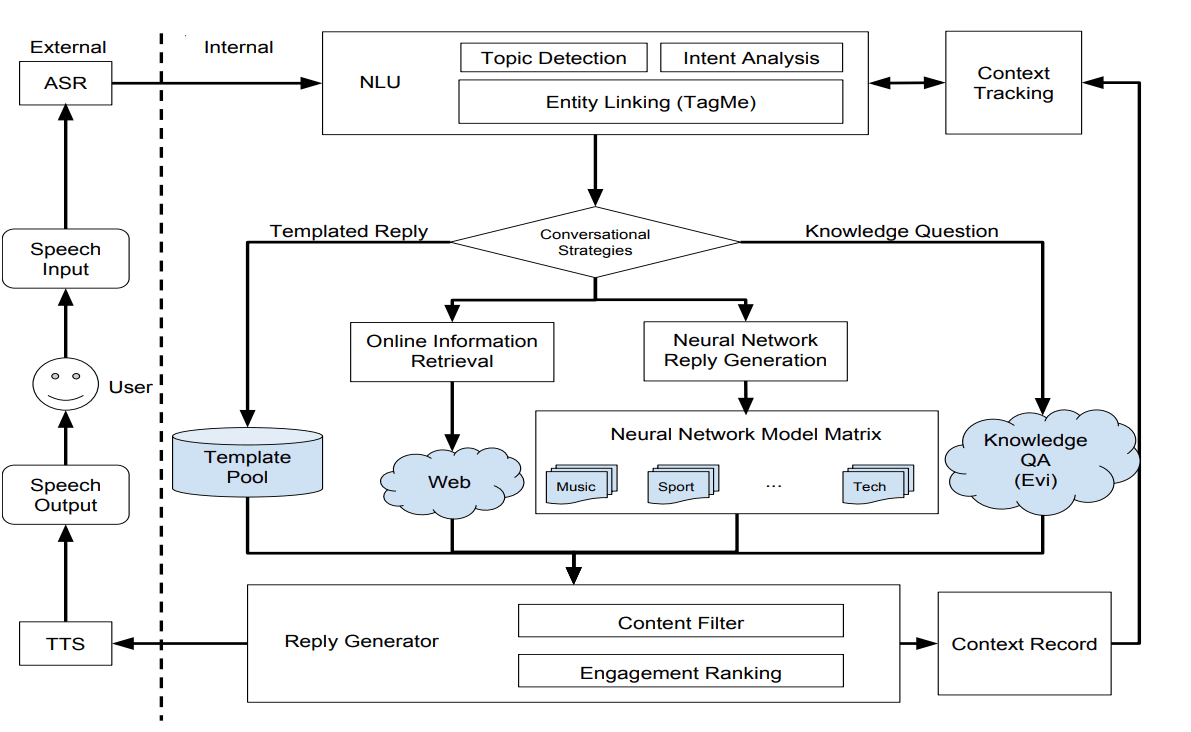
Our ambition was simple: Users should be able to talk freely with a machine, without having to follow a predefined script.
Of course, there was a huge gap between ambition and reality.
Language models at the time were extremely limited. The quality and reliability of generated responses were nowhere near what we take for granted today. Compared with systems built around carefully engineered conversation flows, ours performed poorly. We didn't win the competition. Eventually, with graduation approaching and the pressure of finding jobs mounting, we turned the project into our master's thesis and stopped working on it. Over time, Ruby Star became just another unfinished project tucked away in my memories.
Until today.
That Facebook photo prompted me to dig up our old thesis and read through it again. And suddenly, something clicked:
What we had built ten years ago was essentially a very primitive Agent Harness.
Model Routing, RAG, Memory, Context Engineering... many of the architectural ideas that are fundamental to modern AI agents had early, rudimentary counterparts in our original system.
Of course, that doesn't mean we had somehow built today's agentic system a decade early. Quite the opposite. What we lacked most back then was a sufficiently powerful foundation model.
We were trying to compensate for the limitations of the models through system engineering. But the technology of that era simply wasn't capable of supporting what we imagined.
Sometimes, an idea fails not because the direction is wrong, but simply because the world isn't ready for it yet.
As I realized this, I felt something strangely profound.
It was as if I had fired a shot ten years ago, and the bullet had traveled through an entire decade, only to hit me today.
What I'm building today Twin1 AI as a co-founder with Lewis Z. Liu Jonathan Budd Tom Cahn, using AI-powered digital twins to create intelligent organizations, is, in many ways, a continuation of that unfinished project from ten years ago, only on a much larger scale.
Ten years ago, the question I were trying to answer was: How can we enable a machine to truly engage in open-ended conversation with a person?
Ten years later, the problem I want to solve goes far beyond conversations between humans and AI.
I want to explore how each person's knowledge, experience, and judgment can be understood, connected, and put to work across an entire organization through their own digital twin, so that collaboration between people is no longer constrained by information silos.
We have gone from trying to build a conversational system that could transcend the boundaries between topics to trying to build organizations that can transcend the boundaries of knowledge between people.
The scale of the problem has changed, but what I've been pursuing seems to have remained the same all along.
Technology is finally becoming capable of bringing these ideas to life. And I've been fortunate enough to have more time, more resources, and a group of like-minded people by my side, giving me the opportunity to revisit the things I couldn't finish, or couldn't get right, all those years ago.
It's rare in life to get a second chance, ten years later, to pursue an unfinished dream from your younger days. And since I've been given that chance, I want to do everything I possibly can to take it as far as it can go.